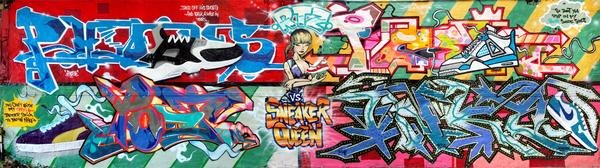
Another HipHop Legend leaves the circle. Rammellezee lost his fight against cancer last night. R.I.P. !
Always ahead of his time, New York artist and performer Rammellzee was born 1960 in Far Rockaway, Queens. Credited with being one of the inventors of graffiti art in the late 1970’s as well as one of the original hip hop artists from the New York area who introduced specific vocal styles which date back to the early 1980s. His influence can still be heard in contemporary artists such as The Beastie Boys and Cypress Hill and his legendary hip-hop single “Beat Bop” with K-Rob was financed by the artist Jean-Michel Basquiat, and has become one of the most sought after hip hop releases ever.
In the mid-80’s, Rammellzee became associated with a group of artists who painted or tagged in a style known as East Village wild style. This was an illegible, dynamic style of writing letters derived originally from the Gothic script of Medieval manuscripts. In 1982, he appeared in the seminal hip hop documentary Wildstyle by Charlie Ahearn, his fame in graffiti circles was established when he painted New York subway trains with Dondi, OU3, and Ink 76, and Doctor Revolt. Rammellzee’s graffiti and artwork are based on his theory of Gothic Futurism, which describes the battle between letters and their symbolic warfare against any standardizations enforced by the rules of the alphabet; his treatise, “Iconic Panzerisms”, details an anarchic plan by which to revise the role and deployment of language in society. Rammellzee’s work has been exhibited internationally. His work is in the collection of the Museum of Modern Art, New York. He performs in self- designed masks and costumes of different characters of his own creation, one featured within his board art named “Reaper Grimm”.”
In febuary 1981 Phil Knight sent Rob Strasser to Holland with the instruction "Sell shoes". When Strasser arrived at his Amsterdamn base he quickly found that Nike had a bad quality reputation amongst european consumers due specifically its production in Korea, image suffered. In America, Nike's Volume came from people wearing athletic shoes to supermarkets and bars. In Europe, life was more formal and sneakers weren't street fashion. Adidas owned the soccer market, their quality was perceived as better and the product was cheaper. To combat the Adidas market Strasser tried to sell the American dream to Europe through running, Nike's heartbeat. He targeted the largest frontline populated country the U.K, 55 million and made Britian's premier distance runner of the 70's and later BBC athletics TV commentator Brendon Foster head of the U.K operations. Foster and Strasser soon realised that to beat Adidas it would have to be football, they signed a deal with English football club Aston Villa and built a soccer boot in Nike's British factory, Barwen. Villa made it to the final in 1982 against Bayern Munich, it was Nike Vs Adidas! Peter Withe scored Villa's winning goal and Nike a name from nowhere held a loft the European Cup. During Strasser's first year in Europe he purchased blank Dutch wooden clogs and had them sprayed and stencilled at the U.K factory with the Nike logo and matchstick heel company name. Strasser shipped 30 pairs Nike in Oregon to the most important Nike people of the time. The clogs were presented at a meeting in Beaverton, each pair had a specific employees name and shoe size written in pencil on the soles. The blue and white shoes pictured above owned by Trainerspotter belonged originally to Lisa Mckillips who joined the company in its BRS early days, 10 months before Steve Prefontain's fatal car accident in 1975. Lisa was and still is a 10k runner, Mckillips is currently Phil's secretary also.
*Thanks to Lisa Mckillips and Nike archive's for their help in uncovering the story behind the unofficial Nike wooden shoes.