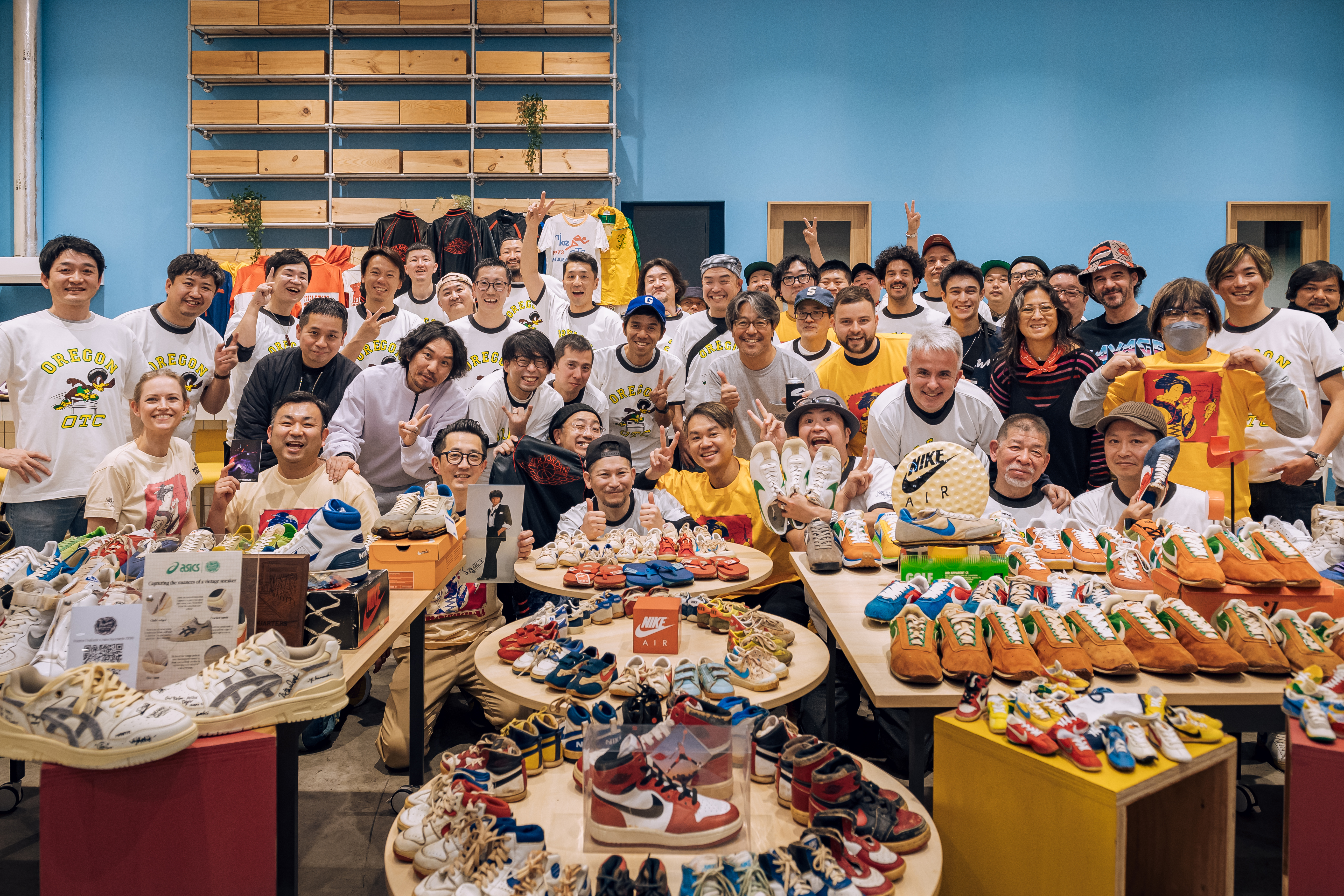
Here some vintage catalog nerdporn to sooth your Wednesday




It ‚only’ took me 2 days to find this pair!
Since the Air Force III has been re-released I wanted to note that the shape has been reissued in a better way before.
Of course still not as good as the original (don’t make me find that one too in this sea of boxes 😅), but better…


With »Nike: Form Follows Motion« the Vitra Design Museum will present the first ever museum exhibition about Nike, the world’s most revered sports brand. The exhibition will explore the company’s five-decade ascent from a grassroots start-up to a global phenomenon. The focus is on Nike’s design history: from the company’s beginnings in the 1960s and the design of its famous »swoosh« logo, to iconic products such as Air Max and Flyknit, and current research devoted to future materials and sustainability. Following the Olympic and Paralympic Summer Games in Paris as well as the European Football Championship in Germany, the exhibition will emphasize the importance of sports for design innovation and social change, while also shedding light on the almost mythical devotion to sneakers and sportswear in popular culture and social media. The exhibition has been initiated and produced by the Vitra Design Museum and curated by Glenn Adamson.
Nike, named after the Greek goddess of victory, is not only a successful company; it is a whole design culture. The proof can be seen almost no matter where you go: a dynamic display of innovative materials, performance features, and high-impact graphics. At the company’s headquarters, just outside Portland, Oregon, products are developed through a unique blend of scientific study, sports research, and aesthetic sensibility. Hundreds of designers there collaborate with specialists in other fields, from material engineering to biology to body mechanics – and, of course, with many of the world’s best athletes.
Now, for the first time, the exhibition »Nike: Form Follows Motion« offers a look behind the scenes of this unique design laboratory while also examining Nike’s involvement with technological innovation and social change. Most of the exhibits are sourced from the Department of Nike Archives (DNA), the company’s own archive, which comprises more than 200,000 items. The exhibition is the first to present a curated selection from this archive to the public. Among the exhibits are rarities and one-offs including experimental prototypes of iconic sneaker models like the Waffle trainer, the Air Force One, and Shox, as well as original design studies for shoes and apparel. The creative contributions of individual designers are highlighted throughout, both those inside the company like Diane Katz, Tinker Hatfield, and Eric Avar, and external collaborators like Marc Newson, Comme des Garçons, and Virgil Abloh. Athletes — from the world’s greatest to the everyday — have also played an especially important role in Nike’s design process by bringing their own experiences and requirements into product development.
The exhibition is structured in four chronological sections. The first, »Track«, delves into the Nike archive’s earliest holdings. The company was founded by two men: Phil Knight, who had been a runner in college, and his former coach Bill Bowerman. Their early employees — and most of their customers — were mainly serious amateurs and collegiate runners, with a few professionals helping to promote the brand. Marketing was hands-on, with sales representatives taking shoes to track meets. In this formative period, Nike established one of its key design principles: always listen to the voice of the athlete. In this part of the exhibition, visitors will encounter stories from the brand’s earliest days, such as the development of the first Waffle Sole in Nike co-founder Bill Bowerman’s kitchen or the story of the Tennessee State University Tigerbelles, a team of black female athletes during the civil rights era in the United States.
The second exhibition chapter, »Air«, looks at the 1980s, when Nike achieved take-off. Through endorsements with star athletes like Michael Jordan, Serena Williams, and LeBron James, the company established itself as a prime mover in popular culture. At the same time, Nike transcended its origins in track and field, expanding first into basketball, then tennis, global football, skateboarding, and other sports. Its designs became fixtures of pop culture, thanks to a crafty understanding of the street-style landscape. Classics like the Air Force 1 and the Air Jordan were featured in imaginative TV commercials (mostly by the Portland-based ad firm Wieden + Kennedy). At the same time, the company was investing in a new technology: capsules of pressurized gas that provided cushioning without adding weight. Initially concealed inside footwear soles, Nike Air was first made visible in the 1987 Air Max, opening up a new chapter in the company’s design history. In the exhibition, the fascinating evolution of the Air sole is illustrated with numerous artefacts from the initial development process, including air bag prototypes and a testing machine created by engineer Frank Rudy, who first developed the technology and proposed it to Nike.
The third space in the show, »Sensation«, explains some of the research and development behind Nike’s designs. Here, visitors get an insight into the heart of the Nike Sport Research Lab, one of the world’s largest and most advanced facilities for the study of the body in motion. Since the 1990s, this technical research has increasingly focused on the advancing athletic potential, leading to products like the Nike Free, which simulates the feel of barefoot running, and the Vaporfly, developed as part of an effort to break the two-hour barrier in the marathon. The gallery shows the impact of material innovations like Flyknit on both performance and sustainability and explores Nike’s current efforts to reduce its own climate impact through ethical material sourcing and circular manufacturing techniques. Nike’s research into plastic recycling is also examined in this section, with examples including Nike Grind —a granulate of recycled items used for a variety of purposes — as well as the company’s journey from the first recycling projects in the early 2000s up to current initiatives.
The culmination of the exhibition, in Room 4, reflects on Nike’s collaborations with external designers, athletes, and its own public. The gallery is a showcase for fifty examples of intriguing and sometimes outrageous footwear from Nike’s history, some developed through collaborations with fashion designers and creatives, others within community-based projects. The room also examines Nike’s eminent role in pop and counterculture, which is illustrated with examples of music videos or Social Media footage that show Nike’s critical role in shaping and reflecting new trends and values. This section underlines that the symbiosis of design and sports has always been about more than just performance. It is also about reflecting ideals of the human body, ideals of well-being, diversity, equality and, ultimately, the deeply human aim to push the boundaries and discover new territory.
Mateo Kries, director of the Vitra Design Museum: »For a long time, we have wanted to organize an exhibition on design and sports. When we approached Nike, we learned more about their incredible design archive — a huge treasure that had never been presented in an exhibition. That was how the idea of this exhibition was born. The show offers a unique opportunity to focus on design through the lens of a single brand, and to display fascinating objects that illustrate the process of design development — some of which have never been shown before.«
Glenn Adamson, curator of the exhibition: »In addition to our interest in the evolution of iconic products, we will look at the larger social and historical context surrounding Nike. Over the past 50 years, sport has had a tremendous impact on our perception of the human body, beyond the track and the court — for example, on conceptions of gender roles. Our exhibition will show how the company has both instigated and responded to these changing dynamics, from its initial emphasis on performance and optimization to greater diversity and inclusion. By looking at Nike’s design strategies, we gain insights into that bigger cultural picture.«
The exhibition will be guided by a broad range of events and workshops on the subject of sports and design. Following its premiere at the Vitra Design Museum, the exhibition will travel to further international museum venues.